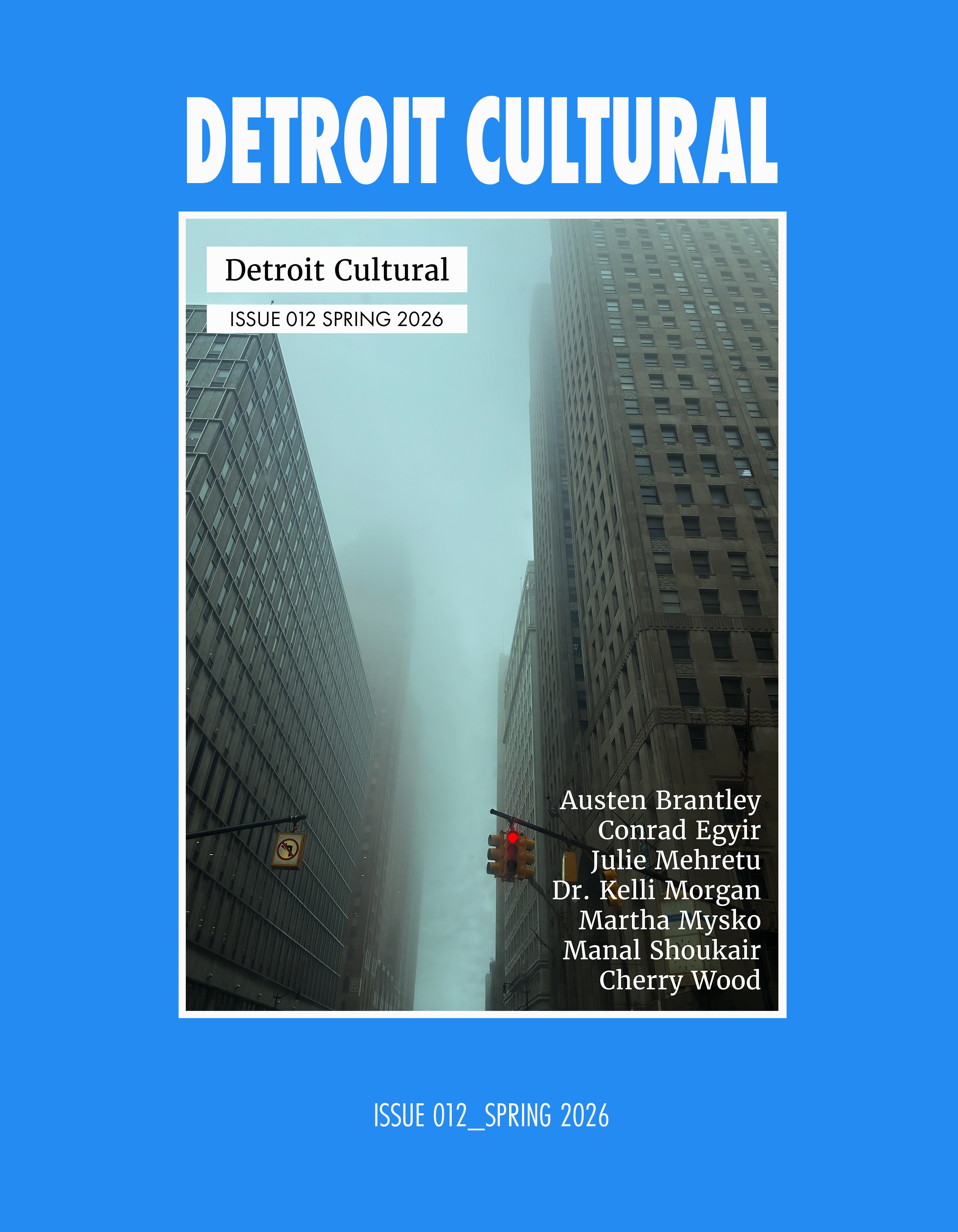
Detroit Cultural
(cultural) x (political) x (social)
Home
Issues
ISSUE 001_SPRING 2019
Ruin Imagery and the Cultural Work It Performs: In Conversation with Dora Apel
Political Art as Spectacle: In Conversation with Taylor Aldridge
The Heidelberg Project and the Politics of Site-Specificity: In Conversation with Rachel Adams
Inclusive and Exclusive Narratives: In Conversation with Juana Williams
The Prefigurative Possibilities of the Art Institution: In Conversation with James McAnally
Appropriation of Black Tragedy and the Implicit Politics of Aesthetics: In Conversation with Aurella Yussuf
Culture as Weapon: In Conversation with Nato Thompson
ISSUE 002_SUMMER 2019
Is Arts Criticism Inherently Political: In Conversation with Sarah Rose Sharp
The Capacity of Art to Change How We Think About Ourselves in the World: In Conversation with Larry Ossei-Mensah
The Responsibilities of Curatorial Practice: In Conversation With Laura Mott
The Branding of Detroit: In Conversation with Aaron Foley
The City as Body: In Conversation with Michael Stone-Richards
The Cycles We Go Through as Humans on Earth: In Conversation with Scott Hocking
ISSUE 003_FALL 2019
Identity, Material, and Culture: In Conversation with Olayami Dabls
Toward Becoming More Creative, Conscious, Self-critical, and Politically and Socially Responsible: In Conversation with Christin Lee
This Must Be The Place: In Conversation With Ellen Rutt
There Is No Neutral Ground Here: In Conversation with Maya Stovall
ISSUE 004_WINTER 2020
Towards a New Relationship With Black Bodies: In Conversation with Ingrid LaFleur
Connecting the Specific to the Universal: In Conversation with Tylonn J. Sawyer
The Relationship Between Knowledge and Power in Art History: In Conversation with Samantha Noel
Many Speaking to Many: In Conversation with Steve Panton and Matthew Piper
ISSUE 005_SPRING 2020
Museums Are Not Neutral: In Conversation with LaTanya S. Autry
Dance as Social Exploration: In Conversation with Biba Bell
Figuring the Subject: In Conversation with Mario Moore
The Social Role of Public Art: In Conversation with Richard Wilson
ISSUE 006_FALL 2020
To Care for the Object: In Conversation with Lauren Jackson Harris
Making the Stone Stonier: In Conversation with Osman Khan
Undoing “America” as a Way of Seeing: In Conversation with Nicholas Mirzoeff
By Teens, For Teens: In Conversation with Morgan Leake and J.J. Thompson of the MOCAD Teen Council
Ritual as a Space of Restoration: In Conversation with Cherise Morris
ISSUE 007_WINTER 2021
Art as a Practice of History, Memory, and Education: In Conversation with Chelsea A. Flowers
What Kind of Futures Artworks Open: In Conversation with Boris Groys
What is Your Medicine: In Conversation with Sabrina Nelson”
What Art Can Be, But Also What Art Can Do: In Conversation with Senghor Reid
Making as an Act of Connection to History and Environment: In Conversation with Ryan Standfest
Making Way to Visibility and Inclusion: In Conversation with Darryl DeAngelo Terrell
ISSUE 008_SPRING 2021
Dual Vision: In Conversation with Nour Ballout
Dual Vision: In Conversation with Betty Brownlee
Dual Vision: In Conversation with Tyanna Buie
Dual Vision: In Conversation with Jim Chatelain
Dual Vision: In Conversation with Amelia Currier
Dual Vision: In Conversation with Cyrah Dardas
Dual Vision: In Conversation with Simone DeSousa
Dual Vision: In Conversation with Chelsea A. Flowers
Dual Vision: In Conversation with Steve Foust
Dual Vision: In Conversation with bree gant
Dual Vision: In Conversation with Mario Moore
Dual Vision: In Conversation with Cherise Morris
Dual Vision: In Conversation with Martha Mysko
Dual Vision: In Conversation with Sabrina Nelson
Dual Vision: In Conversation with Rashaun Rucker
Dual Vision: In Conversation with Robert Sestok
Dual Vision: In Conversation with Carlo Vitale
ISSUE 009_FALL 2021
Iteration as an Approach to Thinking: In Conversation with Emmy Bright
Objects in Circulation: In Conversation with Halima Afi Cassells
Art as the Cornerstone of Change: In Conversation with Bakpak Durden
The Stories We Tell: In Conversation with Cornetta Lane Smith of Detroit Narrative Agency
ISSUE 010_SPRING 2024
“7 Mile and Livernois” Art as Celebration of Collective Identity: In Conversation with Tiff Massey
“Practices of Cultural Memory”: In Conversation with Marcia Black of Black Bottom Archives
“Weapons and White Music” The Weaponization of Culture: In Conversation with Jefferson Pinder
“Skilled Labor” The Social Role of Realism in Contemporary Art: In Conversation with Mario Moore
“A Retelling” History Painting in the 21st Century: In Conversation with Mark Thomas Gibson
ISSUE 011_SUMMER 2025
The Interstitial is Where I Live: In Conversation with Allison Glenn
The Body, the Machine, the Site: In Conversation with Jova Lynne and Marie Madison-Patton
Make Poetry a Public Art: In Conversation with jessica Care moore
To Chart a More Complete Look: In Conversation with Bridget Bartal
A Collective Dream: In Conversation with Jen Barker
Levels of Engagement: In Conversation with Liza Bielby
ISSUE 012_SPRING 2026
Artificial Vision: How AI Reproduces Colonial Frameworks
Burnt Offerings: In Conversation with Austen Brantley
Reframing Visual Languages: In Conversation with Conrad Egyir
The Fugitivity of Our Days: In Conversation with Julie Mehretu
Rewriting the Rules on Art, Whiteness, and Empire: In Conversation with Dr. Kelli Morgan
Indexes of Action: In Conversation with Martha Mysko
Other Ways of Knowing: In Conversation with Manal Shoukair
Where Do Memories Live: In Conversation with Cherry Wood
About Us
Contact
ISSUE 012_SPRING 2026
CONTENTS
Artificial Vision: How AI Reproduces Colonial Frameworks
Essay by Danny VanZandt
Burnt Offerings:
In Conversation with Austin Brantley
Reframing Visual Languages:
In Conversation with Conrad Egyir
The Fugitivity of Our Days
In Conversation with Julie Mehretu
Rewriting the Rules on Art, Whiteness, and Empire:
In Conversation with Dr. Kelli Morgan
Indexes of Action:
In Conversation with Martha Mysko
Other Ways of Knowing
In Conversation with Manal Shoukair
Where Do Memories Live:
In Conversation with Cherry Wood