
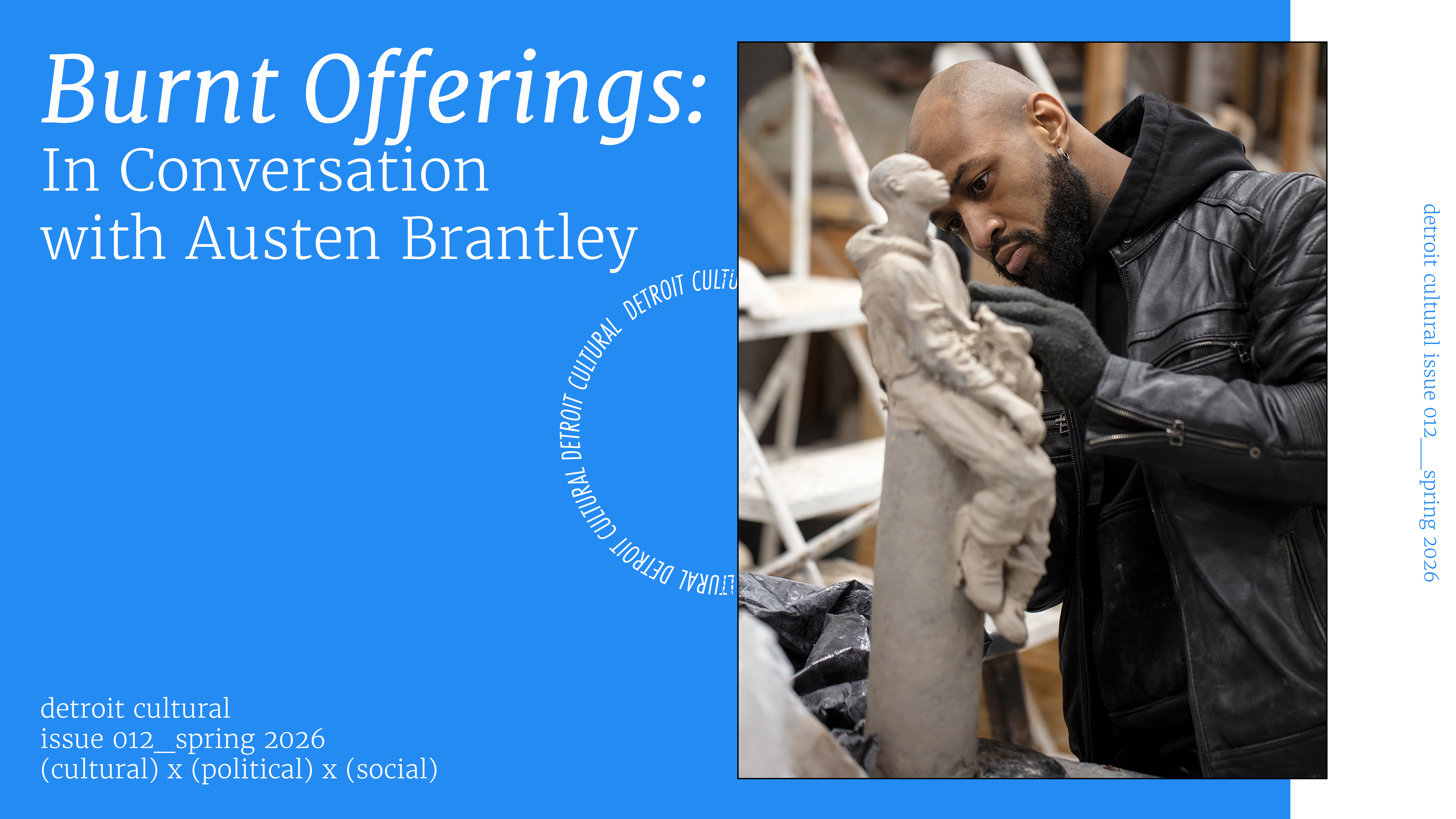
Austen Brantley is a Detroit-based sculptor, known for his ceramic and bronze figurative sculptures, as well as for his many public commissions, such as the Joe Louis “Outside the Ring” statue in Detroit’s Joe Louis Greenway. In 2023 Brantley was the recipient of both the Kresge Arts Fellowship and the National Council on Education for the Ceramic Arts Emerging Artist Fellowship. His work has been featured in numerous group exhibitions around the globe, as well as solo exhibitions throughout the United States. We spoke with him on the occasion of his recent solo exhibition “Burnt Offerings” at M Contemporary Art in Ferndale.
DC: How did you first become interested in working in ceramic sculpture?
I started off in a high school ceramic class where it wasn’t about sculpture. I started doing faces on my own and getting into it, and I think after a year of just playing around in the ceramic studio I kind of developed a talent for it and my classmates and teacher started to notice. It gave me a sense of belonging, just being in the studio working, and it gave me a lot of confidence. I thought maybe I could go to art school, I started training for it.
But I think what really got me interested in being a sculptor was seeing other sculptors make really great work. I took a trip down to New Orleans to visit a brother, and I saw Frederick Hart’s work, he was a sculptor who had passed on but was really prominent in the late 1980s and 1990s. He made this really wonderful commission for the Washington Cathedral called Ex Nihilo, and I saw a fragment of that and that kind of moment made me see the difference between ceramics and sculpture. Ceramics can be anything that’s clay, that’s fired, but that’s what gave me the real introduction to being aware of sculpture as a discipline.
So I saw that work that really inspired me, and then I just kind of imitated it in certain ways, and then it developed into me creating my own voice, which I would say that started in 2013. I couldn’t really afford art school, but I had this drive to see where this goes, and I had no direction or anything. So I went to Oakland Community College, where I took ceramics classes where I used the medium of ceramic to make sculptures— which I think a lot of people don’t really take into consideration how hard that is, because making a vessel or making a pot is one thing, but to translate sculpture into ceramics can be extremely difficult because of the science of understanding ceramics. Pieces have to be fired in the kiln, you have to be aware of the drying points and firing points, and understanding the viscosity of the clay and how if there is water in one air bubble it can literally blow up an entire piece. That kind of knowledge comes with a lot of failure and mistakes that I’ve made. That’s how I got to this point, I’ve made over three thousand sculptures since I’ve started.
This is the body of work that I think really translates that ten year period of making ceramic sculptures. I’ve always made busts because it was just a lot easier for me, I’ve expanded into different ways of showing the figure, but this is my most current work from doing this for the last ten years.
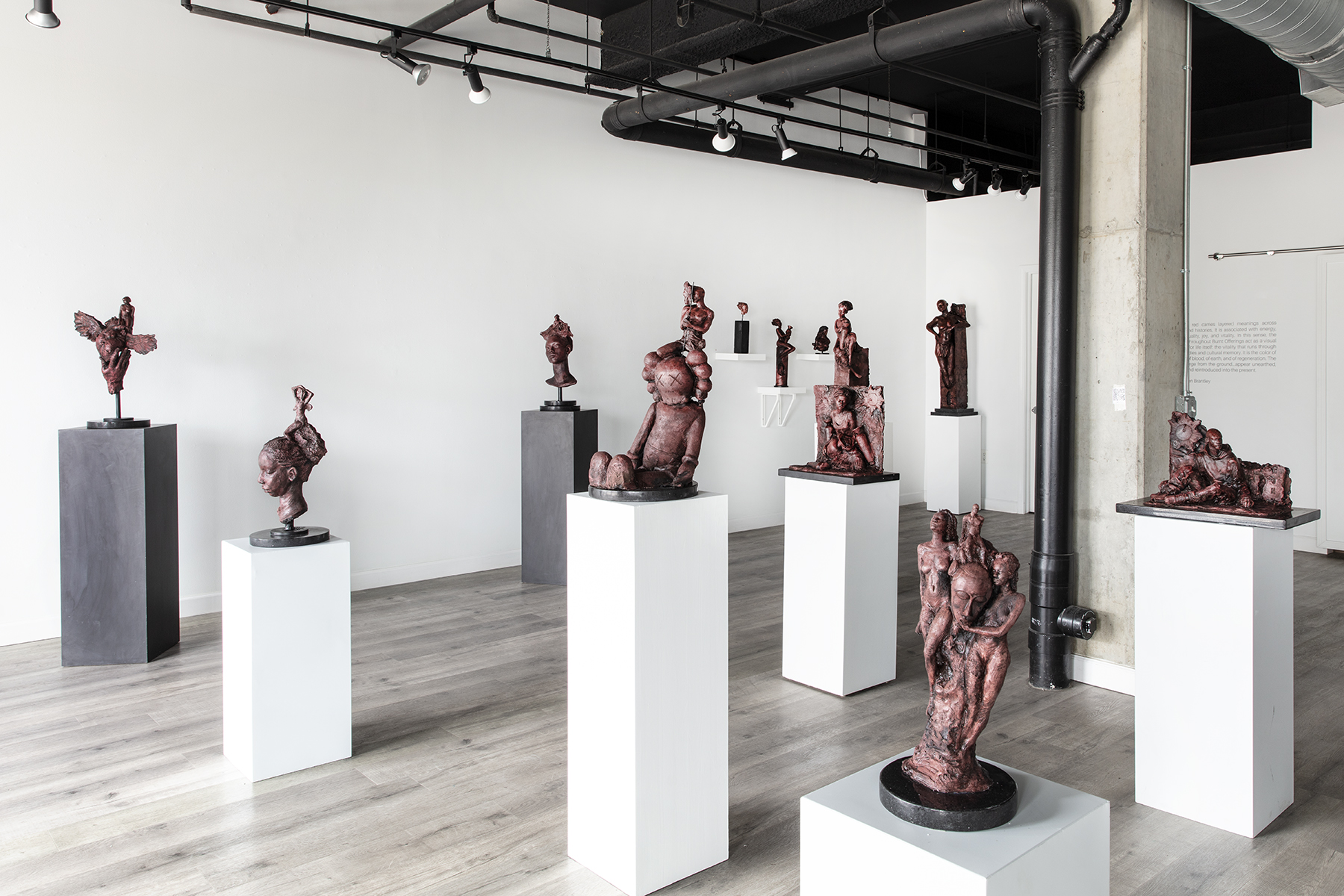
DC: Let’s talk about this new solo exhibition, Burnt Offerings, which you’re showing here at M Contemporary Art in Ferndale. What was the impetus for this body of work? Is there any connective thread between these specific works that ties them together for you?
I think about Burnt Offerings as something in the Old Testament of the Bible, and it talks about burning offerings for God. I think this goes for anybody, but when you’re mastering any craft, that discipline and obedience to your craft is a prayer. It’s being grateful for the gift you’ve been given, so for me the idea of creating this sculptures and literally burning them in a kiln is an offering. I think of all of my pieces as offerings, parts of myself that I’m giving away.
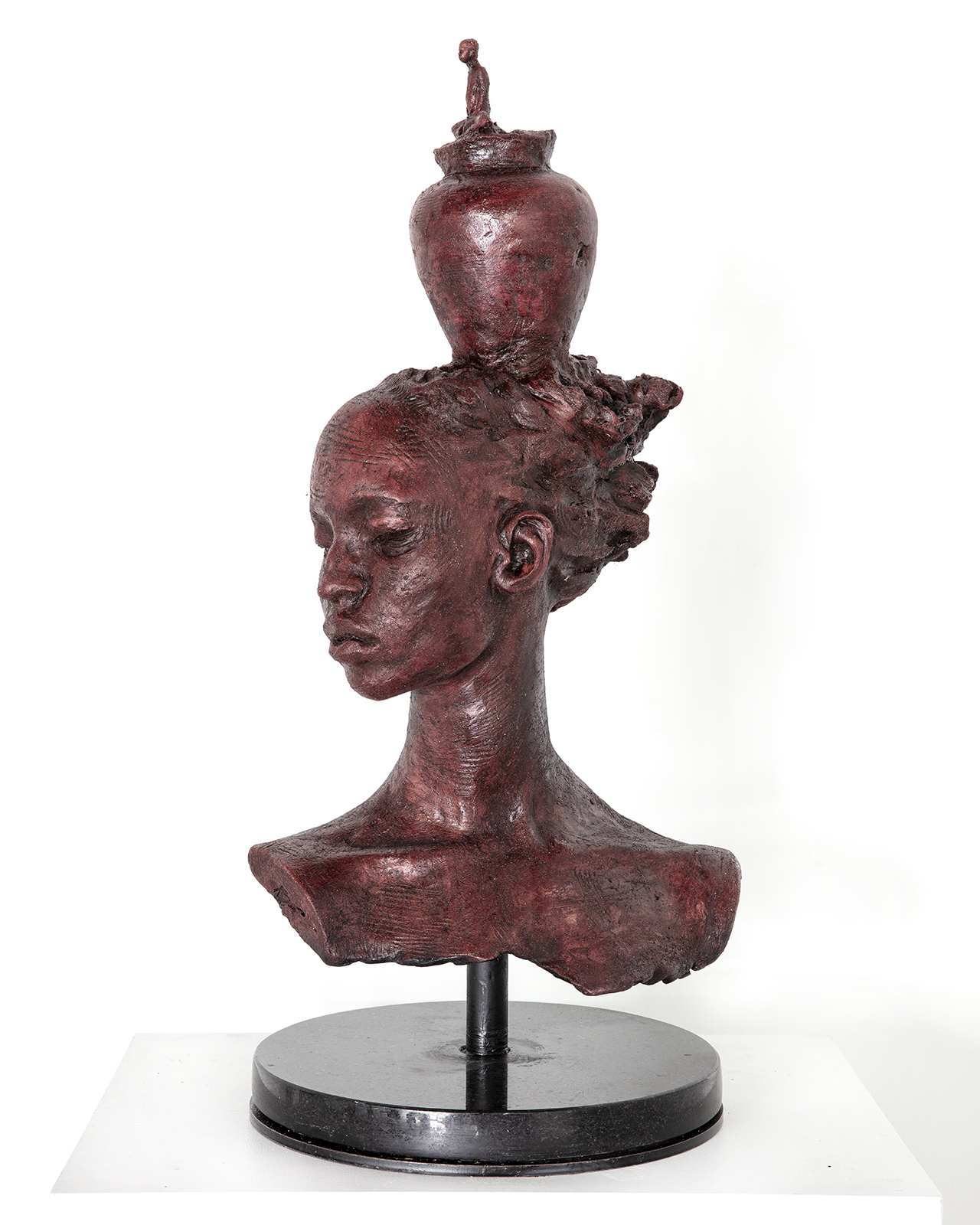
DC: Could you talk to me about this recurring motif in the sculptures of heads with vessels coming out of them, and then those vessels themselves have other figures emerging out of them?
The way I see people, I feel that people are like vessels in a way, you get out what you pour in. These figures are the same in a way. I use the vessels as metaphors for the figures and how they feel, so a lot of the figures have almost like a dilapidation to them, and I did that purposefully because I wanted to convey what the figure might be feeling. It adds to the narrative of the piece, and it shows the visual language of what the piece represents for me.
DC: When you’re making work like this for a gallery show, how does it differ in thought process from when you’re doing the public art that you’ve done?
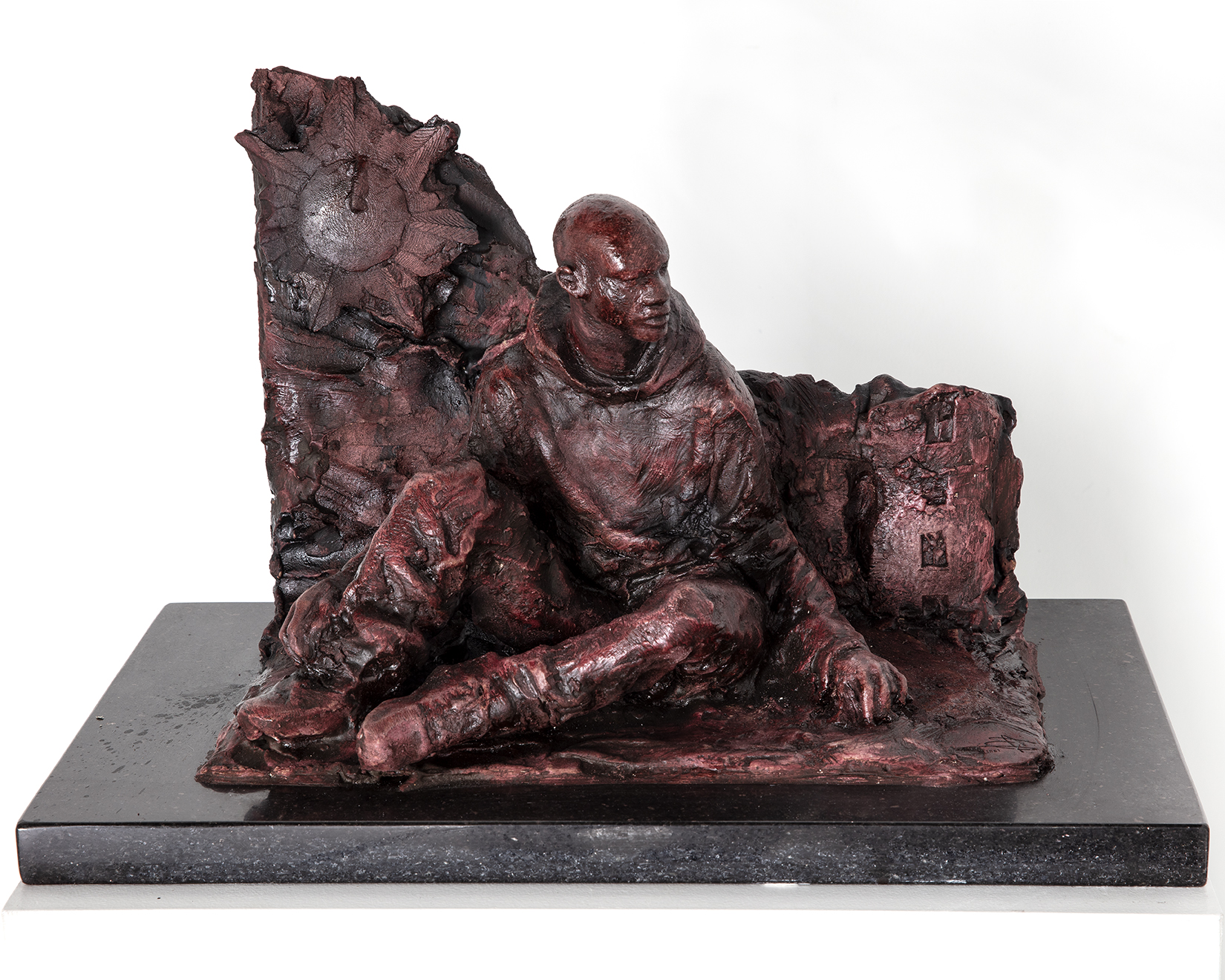
These are done way more intimately, so I would say that I’m making this either for someone’s private collection or for a museum. So its more for that individual person that walks up and delicately scans the piece. I have a lot of small details that you have to get up close to see.
I think it’s a little more political when I’m doing public work. I’m working with organizations, committees, and institutions, that is something I have to adapt to. Usually I’m not allowed to sculpt nudes. Things are more censored. I see that with other works from other sculptors, people will have a problem with even abstracted figures being nude. I think that kind of changes the way I approach creating it, but I’m a rule breaker so I usually will do what I want to. I’d rather ask forgiveness then permission and just express myself.
DC: You’re also an artist who works creating monuments, such as the Joe Louis piece or the First Five. Monuments have been such a divisive thing throughout American history, but especially in this present moment, there’s the Monuments show right now at MOCA Geffen in Los Angeles. What excites about the ability to make a monument? What do you think it can do?
I think of them as a very powerful language to express things. I think the best example is the fist that I made in Montgomery, Alabama. With that piece what I really appreciated is that you can see a young sculptor’s passion in every line, shape, and texture that I added into it. For me, my career has been the same kind of pressure as an Olympic athlete. I work every day from dusk to dawn. I had only seven months to create a ten foot clay sculpture with two life-size figures, and I was also working on two different shows during that time, and another public work. That kind of concentration and focus, creating a monument at that age can say a lot about what they’re focused on.
DC: What do you see as the political responsibilities and opportunities that you see in your work as an artist?
If I do have a social or political responsibility, I don’t see it as something imposed on me from the outside. My primary role as an artist is to observe and create honestly from what I see and feel. Art, to me, should remain a space of freedom—something that isn’t confined or defined by expectations, whether societal or political. It’s important that the work stays authentic rather than reactive.
At the same time, I recognize that, as a Black artist, there is a natural responsibility that comes with my lived experience. I don’t force that into the work, but it’s inherently present. I try to approach my practice with substance—speaking to deeper truths, to history, to cultural memory—because those things are a part of who I am. In that sense, my work can act as a voice for honesty and truth, both within the art world and more broadly.
I think being a cultural pillar is really about authenticity. If something meaningful comes through the work organically, then it carries weight. But if it’s created just to make a statement without being rooted in my vision, then it loses its integrity. Ultimately, I want to create work that is visually powerful and emotionally resonant—something that can offer a sense of healing while still holding truth.
DC: To some degree you’ve talked about there being some politics in the work, in the sense that you want to remain authentic to who you are as a person and artist, but as you begin working on public projects with these institutions there are these ways in which you have to deal with, “how does the institution want me to do this?”
I wouldn’t necessarily describe it as political. For me, it’s more about navigating the balance between maintaining my authenticity and working within the structures of institutions. There can be a lot of external expectations, guidelines, and pressures that come with public projects, and as an artist, you have to find a way to move through that without losing your voice.
At the core of it, my focus is on creating the work—on making sculptures that feel true to my vision. But there is a real weight that comes with sustaining a practice, both creatively and professionally. You’re not only trying to remain grounded in your identity as an artist, but also simply trying to build a life and survive within the field. It’s about learning how to navigate those systems while still protecting the integrity of the work.