
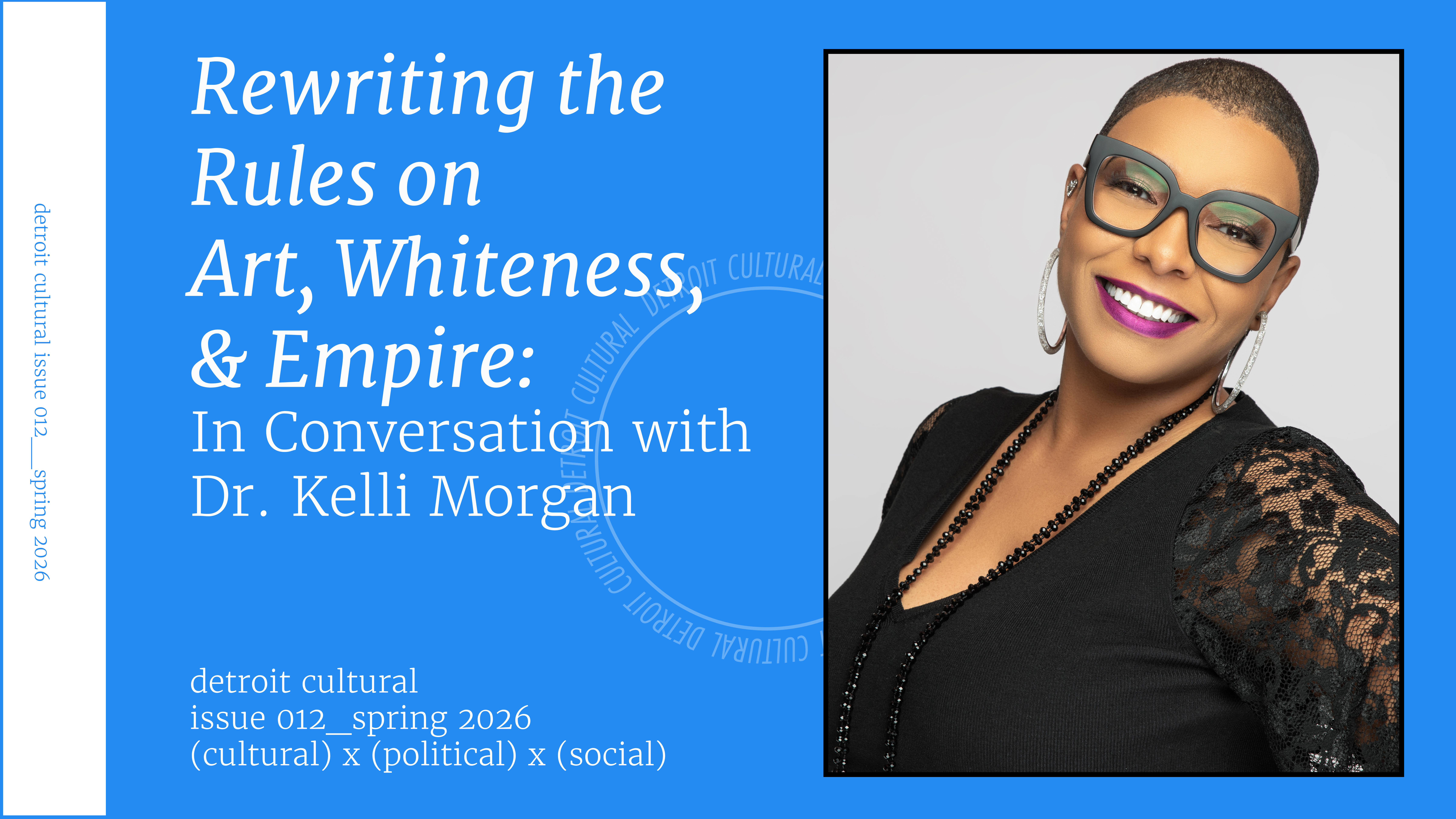
Dr. Kelli Morgan is a Detroit-based curator, educator, and activist. She is the Founding Executive Director and CEO of Black Artists Archive, an archive dedicated to safeguarding and sharing the legacies of Detroit’s Black artists through archival stewardship, dynamic exhibitions, and innovative education. As a curator Dr. Morgan has served as Senior Curator at The Charles H. Wright Museum of African American History, as well as Associate Curator of American Art at the Indianapolis Museum of Art. She was also the Director of Curatorial Studies and Professor of Practice at Tufts University.
We spoke with Dr. Morgan about the history and mission of Black Artists Archive and its learning center, the Black Curatorial Institute.
DC: How did you come to start the Black Artists Archive and the Black Curatorial Institute?
KM: It’s been this interesting, serendipitous road. Technically I’ve been in the field since 2014, and I came back to Detroit in 2023 because my mother and my aunt were aging. They were doing all of this stuff they had no business doing like, “oh we’re going outside to cut the limbs off the pear tree,” or “we gonna get up on this ladder.” Because I really needed them to sit down somewhere, my sister and I had a come to Jesus conversation where she said, “one of us needs to go back home because they are doing too much.”
I came back really just expecting to do independent work, and I got tapped for the Senior Curator position at the Wright Museum. When I started that position, the digital archivist at the time, her name is Ashley Reynolds and she is at Howard now, was working on an oral history project with a lot of the older artists and collectors in the city. Most of them I knew but didn’t know really well, so I would go with her to introduce myself. And when I met Mrs. Shirley Woodson-Reid, she said, “I’ve been following your career on Instagram, and you’re such a dynamo!” That then turned into her asking me if I knew anyone who could help her with her archives and material culture. And this continued with other artists like Dr. Melba Boyd, Dr. Cledie Taylor and Marian Stephens, and I thought to myself “oh my god!” They were all asking if I could help photograph or digitize their holdings, and I knew the Wright Museum didn’t necessarily have the infrastructure or space for the sheer amount of stuff, and that DIA didn’t necessarily collect material culture archives, so I decided to resign and start the Black Artists Archive as a post-custodial digital donation option for artists in Detroit, as well as artists, collectors, and communities across the Midwest.
Because the other key thing here is that most grassroots collectors of Black material culture and cultural history don’t want to give their archives to public institutions anymore and I found that so fascinating. I started calling friends of mine around the country to see what was going on in community archives in their cities, and it was the same narrative: particularly Black artists’ families have wised up to the ways that big commercial galleries often undersell them and the ways that traditional institutional archives acquire the collections but are frequently understaffed and/or under resourced to actually process them. So, they just wind up in storage rooms that nobody can access for eons. Which again, blew my mind, because since the 90’s there had been this kind of credence among Black artists and collectors to be able to say, “oh my papers are at the Smithsonian,” or “we gave grandmom’s papers to American Archives” and that has changed rapidly at the grassroots level.
The third aspect of this was that the collections weren’t in bad condition. Traditional institutional narratives have historically touted this idea of having to “save” Black materials from permanent lost or damage. Which is the traditional (typical) colonial sentiment. And where that’s happened in some of cases, I think of Dox Thrash’s case in Philly, most Black folks are keeping their stuff in great condition. Now, it may not be organized! But it is being stored properly. So I thought, if we shift to digitizing these collections, kids, grandkids, and communities can continue to keep it, store it, and steward it. That’s another shift I see now, previously in my career the kids or the grandkids didn’t want to hold onto the stuff, but that’s changed too. This is something I saw first-hand through Ali Wheeler and Alima Wheeler-Trapp, the stewards of The Black Canon, which is their father James Wheeler’s collection of Black film, film ephemera, and so much more. And again, it’s happening all over the country. Samella Lewis’s grandson, Unity Lewis, is doing some phenomenal digital work with her Black Artists on Art archive.
So, I wanted to create BAA as a digital platform/archive option for families who specifically wanted people to have public access to their materials but did not necessarily want to give their collections to a public institution. I basically created it so we could keep our stuff.
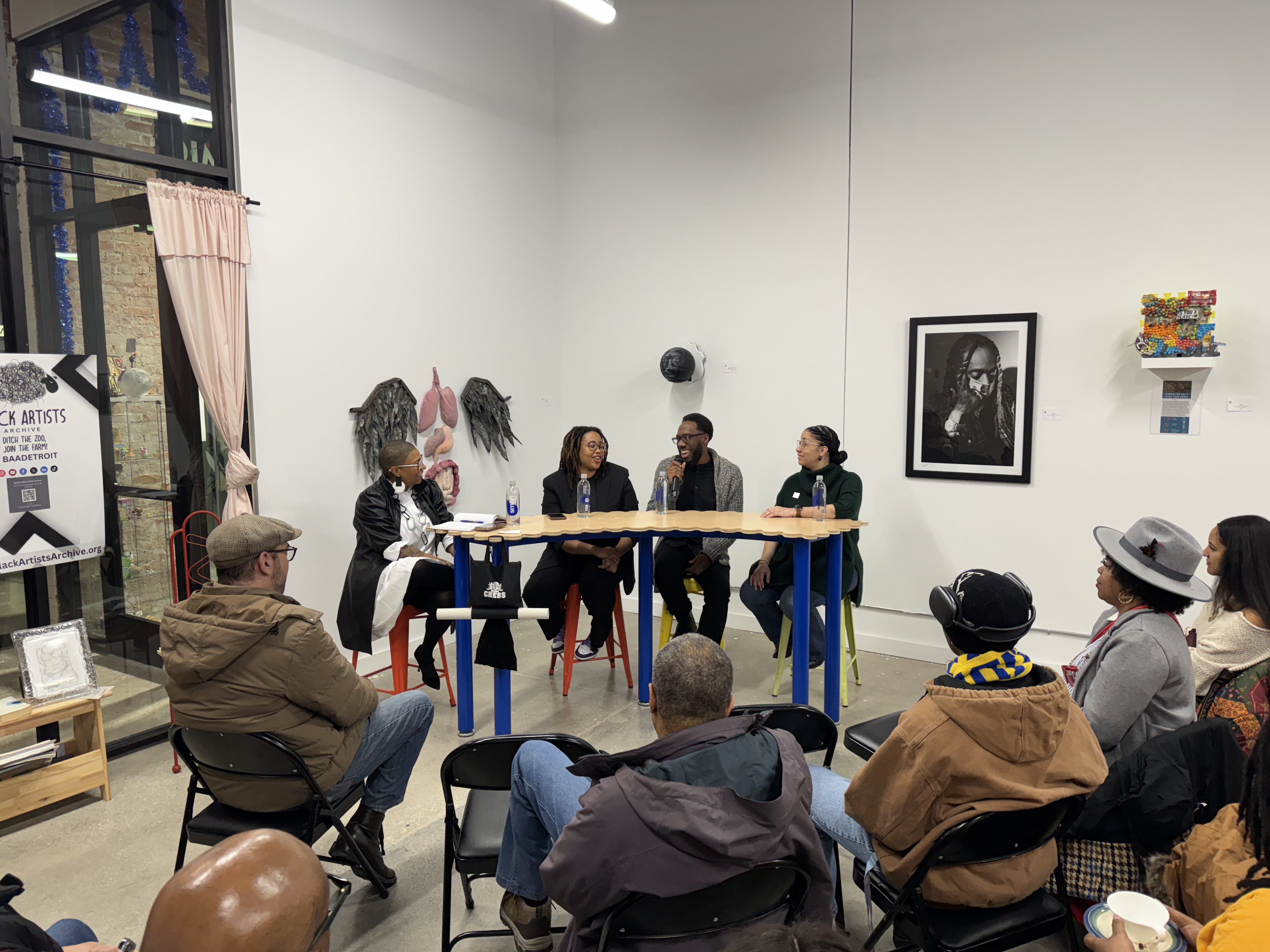
DC: And how about the Black Curatorial Institute?
KM: Black Curatorial Institute began as a graduate certificate program that I was hired to create at Tufts University in 2021. There, I built a curriculum, which centered anti-racist curatorial approaches. This was after the George Floyd, Breonna Taylor moment that caused a type of racial reckoning in the field. Now, in hindsight, I know that the interest in the program itself was actually white-liberal virtue-signaling. So, I was like a diversity hire. Nevertheless, I built the curriculum and they wanted to charge the full graduate-level tuition price, which was like $40,000. But me being me, I was like there is no way I’m asking students to spend $40,000 for an online certificate. I eventually got them to come down on the per credit price, but the total price was still in the five figure range. So, my wheels started turning and I realized that because of the political tenor in the country at the time, specifically the explosion of DEI programming, offices, etc. that were coming out of the woodwork, the certificate itself was slated to be a cash cow for Tufts. And what better way to “sell” the validity of said “cash cow” than to put my face on it, straight off the Newfields controversy. So, I did what I always do, I studied what was really happening at Tufts on the admin level and figured out how I could use my position as Program Director to undermine it. And my results were phenomenal for art & cultural professionals who didn’t have to proper tools to navigate their institutions.
Canvas was the platform Tufts used to host the program, and basically all its virtual learning. However, as an institution, Tufts was severely behind on best practices and logistics in online teaching in general. I, on the other hand, have been immersed in virtual learning since 2011, and I discovered that the school’s Canvas course links weren’t actually connected to the university’s registration system. Thus, I could just send the course link out to interested people and they could basically take the classes for free. I did this with about 85 people over three total courses and realized that “I don’t necessarily need a university to teach this material, I really just need a robust online platform.” Arts & culture folks responded immensely, and at all different levels too—senior folks in museums, some practicing artists, some who had just finished undergrad and grad students. Another thing was, some of my Tufts colleagues, who also saw the potential in what I was doing asked, “have you ever thought about Coursera.” But, I had no idea what Coursera was. It’s a teaching platform specifically for individuals who are connected to major companies and organizations worldwide. So, say you’re a designer or coder at Google and you want to teach a course, you can register on Coursera and you can teach a course as a Google employee. But you have to be connected to a major corporation or institution, and I was totally getting ready to quit! Then, in 2024 I learned about Teachable, which is also a free platform where people are teaching knitting and Photoshop for pretty cheap. My classes are much more robust and my price points are higher. So, I wasn’t sure how they would perform on Teachable. But integrating all my courses was pretty seamless because Teachable is very similar to Canvas.
DC: And you’ve been doing it for how long?
KM: I started BCI the fall of 2024, but I didn’t promote it because I didn’t have the time or the marketing dollars. I’ve just recently begun promoting. Currently I have 112 enrollees across five classes total. And the BCI community stretches across 12 countries and four continents, which I have to say is pretty f-ing cool! All courses are self-paced and there are several affordable payment options.
DC: Could you share some of the readings that you’ve been curating for these classes?
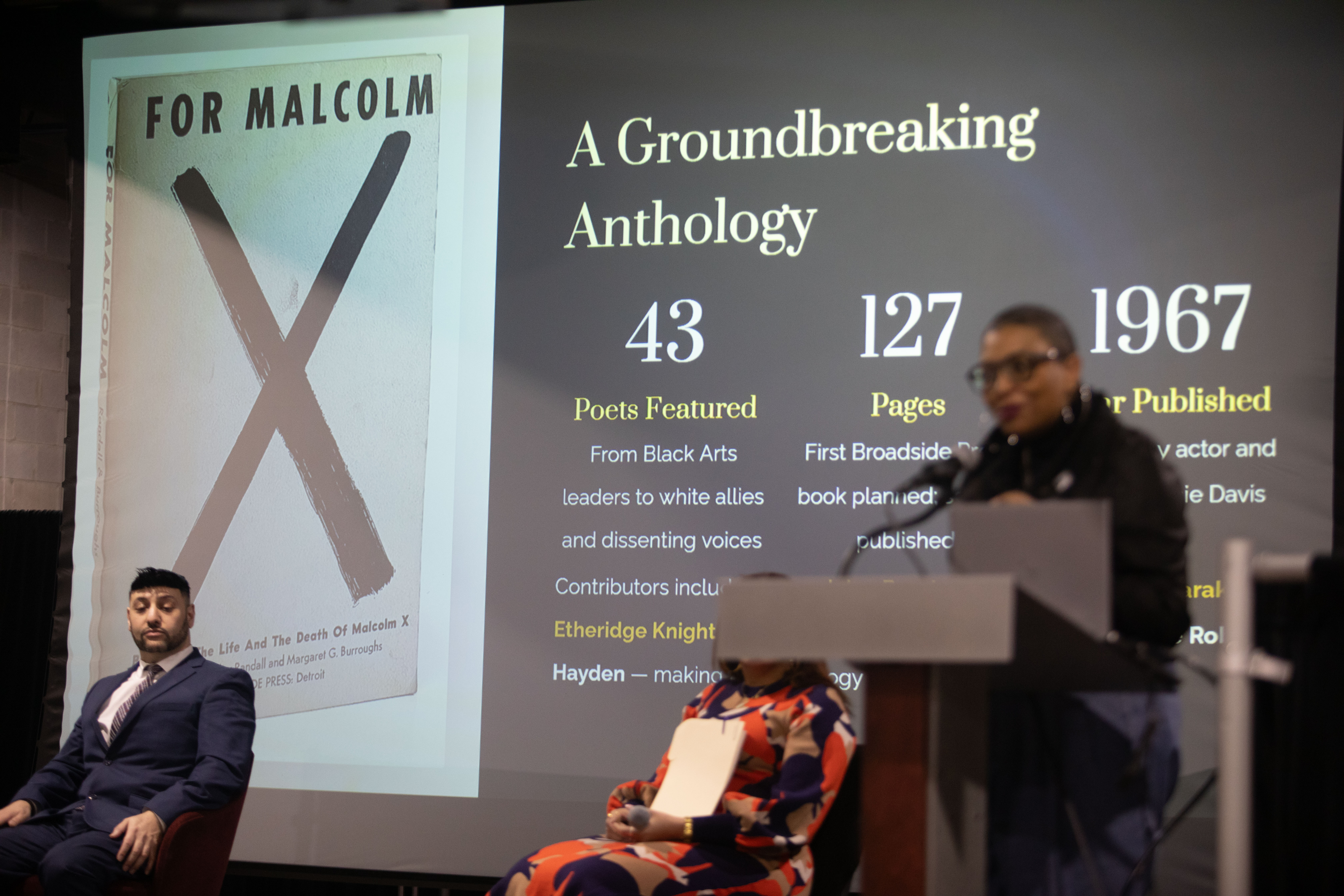
KM: Sure, Anti-Racist Approaches is what I call our teaser course. Overall BCI is a curriculum of five courses that give you this super deep dive into why traditional institutions uphold the colonial models that they do. Additionally, the curriculum teaches you how to recognize those discriminatory models, challenge them, undermine them, and build complete new in the face of them. The whole five-course package is like five-thousand dollars. But I know my demographic and most individual arts professionals can’t afford that. So, I wanted to create something that was significantly cheaper (easy to allocate professional development funds to) but robust enough to offer a good immersion into what the overall curriculum does, and Anti-Racist Approaches is that.
It’s seven modules, including one module from each of the other five BCI courses. BCI courses are also organized around two core pillars: Professional Development & African Diasporic Histories. These pillars are not treated as separate tracks, but are intentionally woven throughout the curriculum, ensuring that historical inquiry and professional practice inform one another at every stage of learning. Also, there are five core areas to the BCI program. The first is Art Museum History, which is a radical reframing of the history of art museums, art history and anthropology as disciplines.
DC: This is the stuff I’m most interested in, because I think you can approach this fields and think that they are objective or neutral fields, but then when you find out their histories, it opens it all up.
All of my training is in Black Studies, so when I came to museum work and art history—I always say I fell into it or God led me to it, because this was so not the plan—but it was that for me too, Danny, discovering that basically it’s all a lie. It’s all been constructed, and you can literally trace it from the 14th century Medici dynasty in Italy, through to the Enlightenment. They literally made it all up. But, again who is reading this scholarship on a regular basis? And there is hardly any art history program that is teaching it. So I was like, “how can I synthesize this history into a module where people can get a sense of how this stuff still affects their daily professions?” More specifically, how can I teach scholars like Jennifer Morgan, Nizan Shaked, Eilean Hooper-Greenhill and Tony Bennett to demonstrate that both the museum complex and art history and anthropology were all about establishing white patriarchal power and control over the world. The class that goes super deep into this is Art, Whiteness, and Empire. I talk about the two Medici popes, how they had the banking system, plus the Catholic Church, and how all of this stuff was establishing the functionality of global capitalism. I don’t go into this part in the course, I mainly focus on Italy, Spain, and Portugal but there is an Austrian story to this history, and a German story to this history, there is a Russian story to this history. It’s wild! The Brits and the French are kind of late, they don’t show up until the 17th and 18th centuries. But the entire time, as these European monarchies were developing wunderkammers, they were also, very deliberately, constructing race and gender.
The second core focus area is Counter-Hegemonic Approaches, with that module I introduce people to LaTanya S. Autry and Mike Murawski’s work, Strike MoMA, Nina Simon, people who are working in completely different methodologies that get the work done. The third core area is Connection to Practice, and those modules delineate Black Feminist Theory, I use Patricia Hill Collins, bell hooks, Audre Lorde, and Porchia Moore. It looks at the way that Black Feminist Theory works to create more inclusive environments. That area also looks at how you synthesize something like bell hooks’ Teaching to Transgress into real, practical application.
The next one is Community Impact, and for that one I look at Seitu Jones’ work, particularly his The Community Meal project. It’s an ongoing social practice artwork, that demonstrates how you build healthy, reciprocal relationships with communities. The Clay Studio in Philadelphia is another case study that I use for that module. In the process of gentrification in North East Philadelphia the organization acquired some land for an amazing price, and they built this new state-of-the-art building, which opened in 2022. In 2016, I met Jennifer Zwilling, who is The Clay Studio’s Art Director—and I had been utilizing a lot of these methodologies in my own curatorial practice—for coffee, and she told me they had gotten this land and that they were going to move into this primarily Black and brown neighborhood. But she explained how they didn’t want to go in as the white women who are coming to save the day. So she asked, “what do we do?” And I said you have to go and see what people are already doing, go to the community meetings, introduce yourself, and just listen. And at the time I didn’t know, but she and her two colleagues Josie Bockelman and Jen Martin, the organization’s CEO & COO actually did that. Next, we started walking this journey together of them implementing a lot of the frameworks I teach, as well as those that I created. Today, Clay Studio is this amazing institution that is holistically designed around the people who live in North East Philly.
The last pillar is Ethics and Equity, and in that area I’m very deliberate about laying out, “here are the rules”, according to the American Alliance of Museums and the Association of Art Museum Directors, but here is the reality. Meaning, here are all the unethical and illegal activities happening every day at your friendly local art museum. And of course, Christie’s and Sotheby’s. Those modules ask students rhetorically: why they think the rules and ethical guidelines for the field are so vague and full of loopholes. Then the course dives into the actual reasons why the field is designed like that. I use Museums and Wealth by Nizan Shaked and Politics of Collecting: Race and the Aestheticization of Politics by Eunsong Kim, which is a new book that came out last year. Eunsong’s work is so dope because she is using people like DuBois and other early 20th century and late 19th century Black scholars to show how this has been a thing since slavery. Which I found so affirming because certain colleagues at Tufts were looking at me crazy when I opened Art, Whiteness, and Empire with Du Bois and Aimé Céasire.
Kim looks at Henry Clay Frick and Carnegie, their actual acquisition records, and how the more they were exploiting workers, the money that they made they were using it to buy art and start museums. Nizan does a similar thing with Rockefeller and MoMA, which is a direct extension of what the Medicis were doing in the Renaissance. And what most European monarchies were doing with Wunderkammers. Again, this scholarship was so affirming because I’d demonstrated the same history and methodology between the Tiffany window, President Benjamin Harrison, and lynching in my reinstallation at Newfields in 2019. I’ve always been ahead of the field in that way, but it’s also ridiculously hard to always be ahead of the field in that way.
DC: I read the article that you wrote for Burnaway, “To Bear Witness: Real Talk About White Supremacy in Art Museums Today”, and it was so interesting reading now after the first year of Trump’s second term in which he had seemed so hyper-focused on culture and history—its as if he’s from that field or something, his interesting in architecture, culture, and history—I’m curious what your thoughts are on that first year in terms of Trump’s approach to the Smithsonian, the Venice Bienalle, and the “Restoring Truth and Sanity” executive order?
KM: What was interesting to me was—coming from Black Studies and being from Detroit, I have always had a really nuanced understanding of race, particularly whiteness—and by the time I wrote, “To Bear Witness” in relationship to where we are now, I was seeing that whiteness as a structure is something that affects us all negatively, and it affects us all differently, including white people.
It’s not just people of color, we’ve fought it for so long cause we had to, and we’ve been acutely aware of it in a very nuanced and specific way. So, when Trump took office I was kind of prepared, I remember talking to my colleagues and telling them that I wasn’t applying for any federal grants because I thought he would be elected again. Now, I didn’t know it was going to be as bad as it is, but when I saw those first executive orders I was like, “oh he’s re-establishing whiteness as our primary national framework.”
DC: When you speak of “whiteness” let me confirm I understand what you’re speaking of, is this “whiteness” as just the supposedly neutral way of understanding history and reality, all of these fields that have emerged out of the European Enlightenment but are presented today in school as if they aren’t of any specific cultural history but are just neutral or objective.
KM: Exactly. And that’s the root of the lie itself. Unfortunately, it’s a lie we’ve all been taught and extremely socialized into. Also, White-Male-Patriarchal-Capitalism is really what I mean when I say, “whiteness.” Another story I will share with you that was so mind blowing for me was in 2016 when I was teaching a Black Contemporary Art course at Temple, and one of my white, male students just had a breakdown. He was like, “I don’t feel like this, I don’t subscribe to this stuff.” And he was talking about racism, sexism, misogyny, etc. And that was the first time that I saw how all this shit affects my white students differently, but just as corrosively as its affecting my queer students, and my students of color. That was really an eye-opening moment for me because I could see his pain. And honestly, up to that point, my full attention was on my Black and Brown students. I was extremely hard on my white students. But that moment allowed me to see him in this kind of succession with my Black female students, my trans students, my queer students, etc. And I saw that this was affecting all of them as a generation. That’s when I stopped saying, “racism”, and started saying, “White-Male-Patriarchal-Capitalism.” Even in that problematic internet bro culture, same thing, they’re having this sort of cognitive dissonance because they can’t access how the world is changing outside of White-Male-Patriarchal-Capitalism as they know it. And Trump is really trying to re-establish that for people.
DC: What do you see as the political responsibilities and opportunities of your work, either as curator or educator?
KM: The responsibilities are really the core pillars of my practice: care, empowerment, and community. I’ve always done shows or worked on initiatives with the idea that people have to be able to take something tangible from this, other than the pretty notecard. How can you apply this in your day-to-day life in a way that is actually helpful and beneficial to you and those around you. That’s why I do the work that I do. It’s why I invest some much time into it and my students, because I need to know that they’re going to be ok when they leave my classroom, when they finish my essay, or when they leave a show I curated. I think that’s the responsibility.
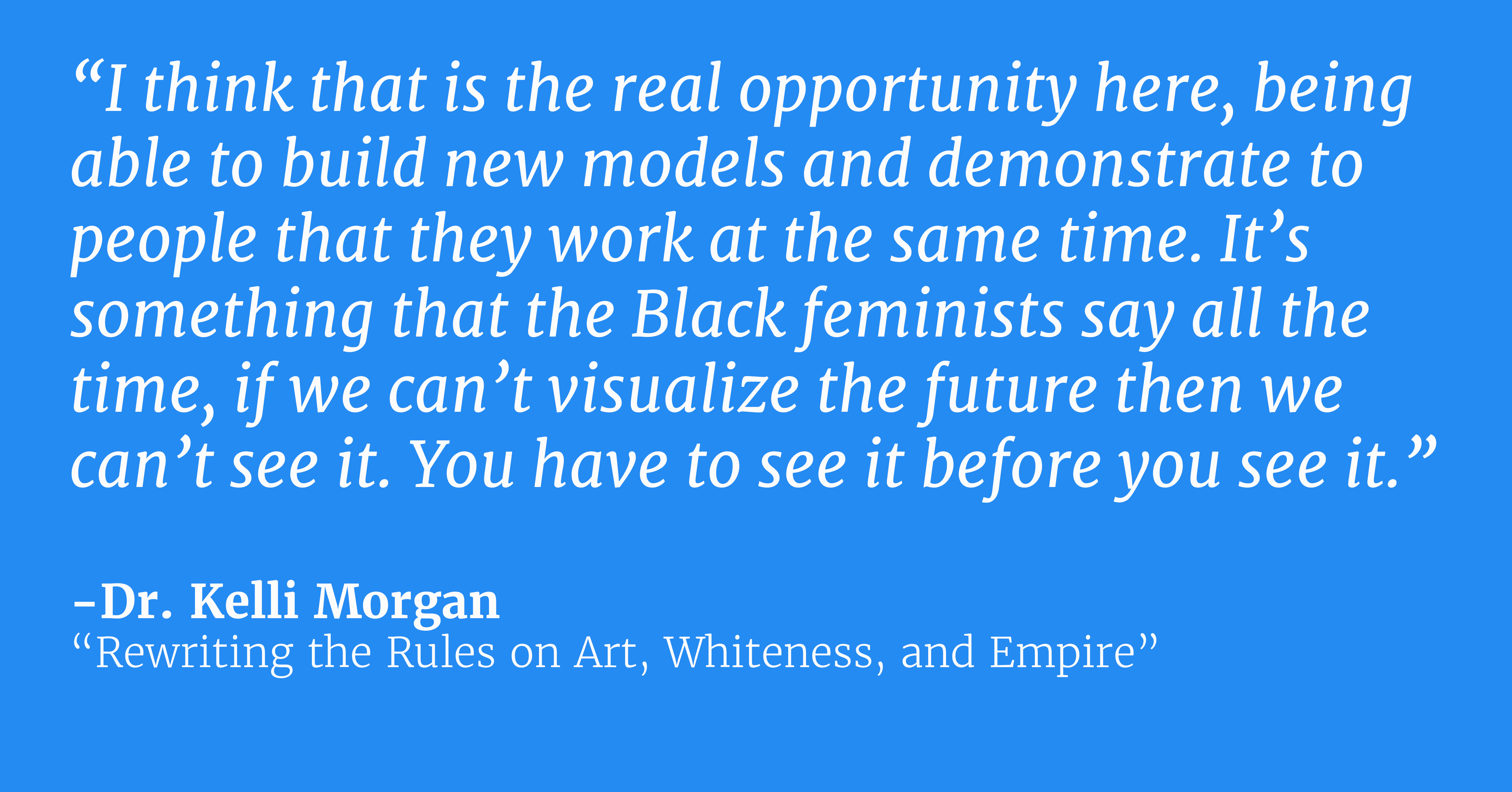
I think the opportunity is to show people, particularly in this moment, that there are other ways, and you don’t have to just accept—if I had a dime for every time somebody said, “you can’t do that like that” and I did it and it was fine—the status quo. You don’t just have to roll over to what’s already been done before. You don’t have to mold yourself or your career around the elite professionals of the field and what they think is “right.” I think that is the real opportunity here, being able to build new models and demonstrate to people that they work at the same time. It’s something that the Black feminists say all the time, if we can’t visualize the future then we can’t see it. You have to see it before you see it. I think that’s something that has been prominent in the field these days, particularly on the Black arts side, are these new futures. Dreaming otherwise, imagining otherwise, we have to be able to imagine what the new thing will be. I’m very much a practitioner, imagination is cool but what is the actual process of trying to build it and what are the pitfalls? What did you think would work that didn’t? With BAA and BCI, I want it to be a model that is easily replicable if it can apply to what you’re trying to do.
DC: It’s wild how everything you’re saying both applies to art, “a new of way seeing, a new way of imagining the world,” but also applies to democracy and the state, and what is the model, how do we learn from the failures?
KM:I think the writing is on the wall. America democracy as we know it, the federal government, structure as we know it is done. As AOC would say, we’re not going back to brunch. It’s done. We are going to have to build something new.