
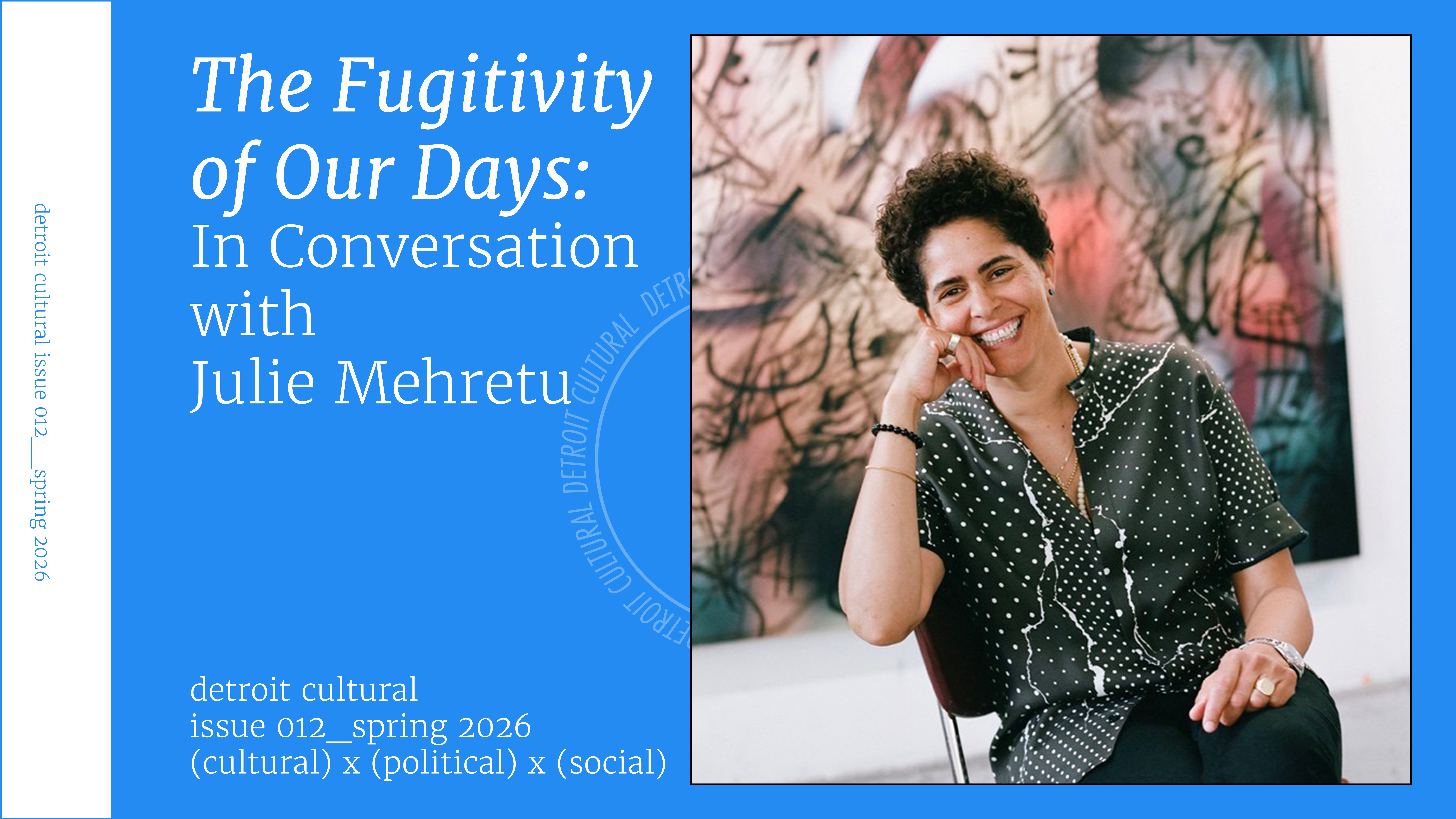
Julie Mehretu, American (b. 1970, Addis Ababa, Ethiopia) lives and works in New York City. She received a B.A. from Kalamazoo College, Michigan, studied at the University Cheik Anta Diop, Dakar Senegal, and received a Master of Fine Arts with honors from The Rhode Island School of Design in 1997. She has received many prestigious awards including the MacArthur Fellowship in 2005, the U.S. Department of State Medal of Arts Award in 2015, membership to the American Academy of Arts and Sciences, 2021, and the Officer of the Ordre des Arts et des Lettres by the French Ministry of Culture in 2025. Her work has been exhibited extensively in museums and biennials including the Carnegie International (2004–05), Sydney Biennial (2006), Solomon R. Guggenheim Museum, New York (2010), dOCUMENTA (13) (2012), Sharjah Biennial (2015), Museu de Arte Contemporânea de Serralves, Porto, Portugal (2017), Kettle’s Yard, University of Cambridge, UK (2019); and the 58th International Art Exhibition, La Biennale di Venezia, (2019).
DC: I’d love to begin with your brand-new solo exhibition, Our Days, Like a Shadow (a non-abiding hauntology) at Marian Goodman Gallery in New York City, which includes a new body of work made between 2023 and now. How did this show come together? When did you realize you had a new body of work to show?
Having a date for a show encourages bodies of work to be developed. It’s not always that the work comes first. Deadlines are helpful.
I’ve been working on many different cycles of paintings. I did an exhibition in 2024 at White Cube in London, and it had a cycle of Black Paintings, my first cycle of TRANSpaintings, and a cycle of blurred paintings before that. This exhibition continues with a lot of the investigations I was engaging in during that period and pushes them even further. I was able to push that and bring new materials and pigments into the paintings. I worked with new interference paints in the Black Paintings, and I was able to further develop the TRANSpaintings from the back and front in new ways. Even though they’re new bodies of work, they’re part of a continuum.
I also give a lot of thought to how they will be exhibited: do I include all of them, do I include some of them, which are the successful ones? I think that’s always part of the process of developing a show. Even though paintings are individual works, exhibitions are also about the relationality between the paintings. I think in this exhibition I was thinking a lot about these three phases in the context of the gallery’s three floors, as each floor creates a unique kind of space for each grouping of paintings.
DC: Could you talk a little bit about what connections you see between these three groups, and also how they relate to the title of the exhibition? I’m specifically curious about your use of the term hauntology which has been reappearing in your work lately.
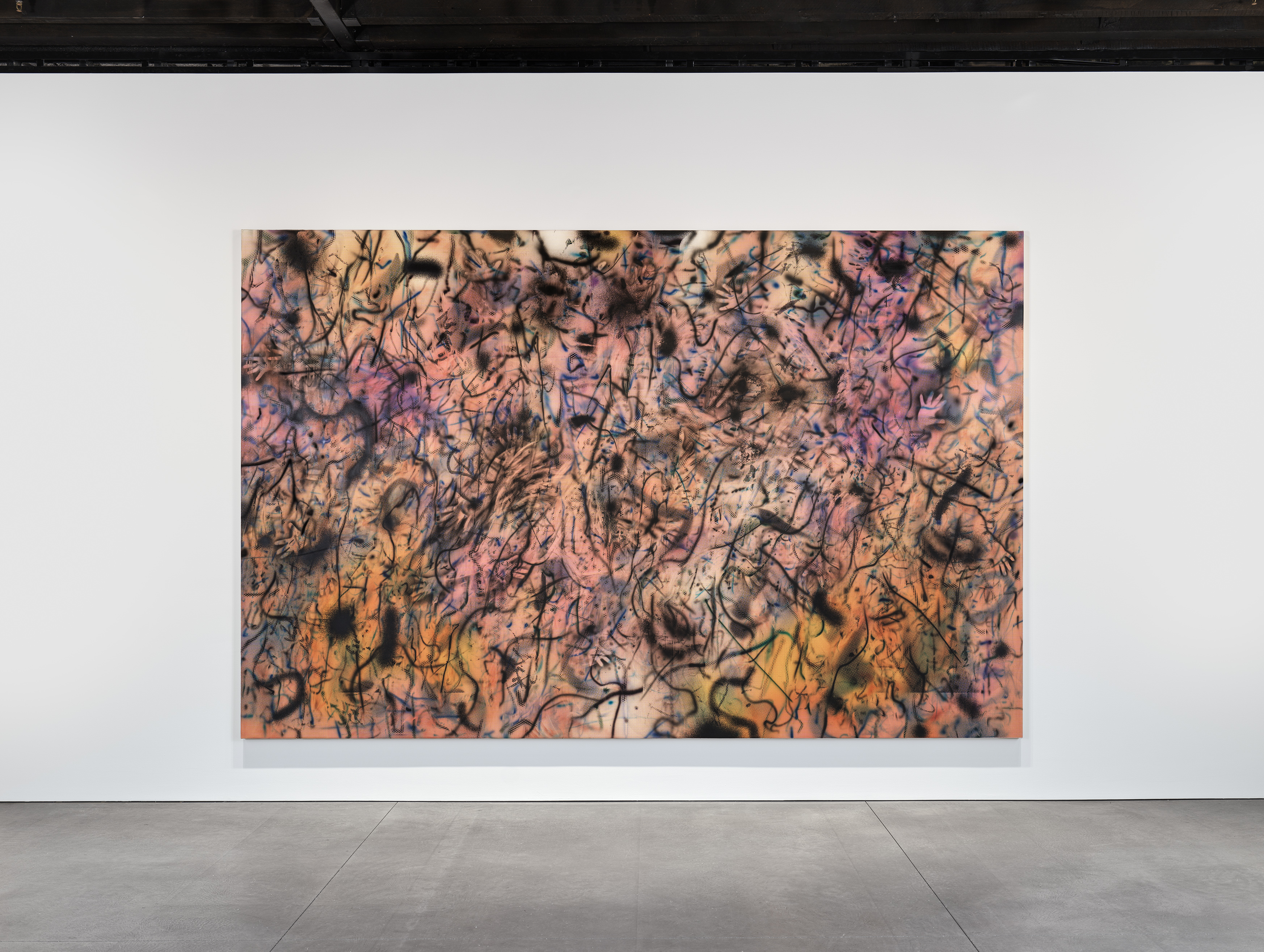
When you walk into Marian Goodman Gallery, you notice that the first floor is the largest gallery in the building. Marian Goodman Gallery is a vertical gallery (unlike most galleries), and the first floor has the highest ceilings, it’s the largest and grandest of the spaces. This is why I placed the largest painting on the first floor. It’s at a much larger scale than the other paintings in the show, and it feels much more cosmological in the way that it’s materialized and the way it’s developed. Then I placed two of the larger TRANSpaintings as two anchors on either side of that main gallery. So we have these three pieces in the first gallery. And then the second gallery that’s adjacent to that has just one painting, and that kind of sets the stage for the next two floors.
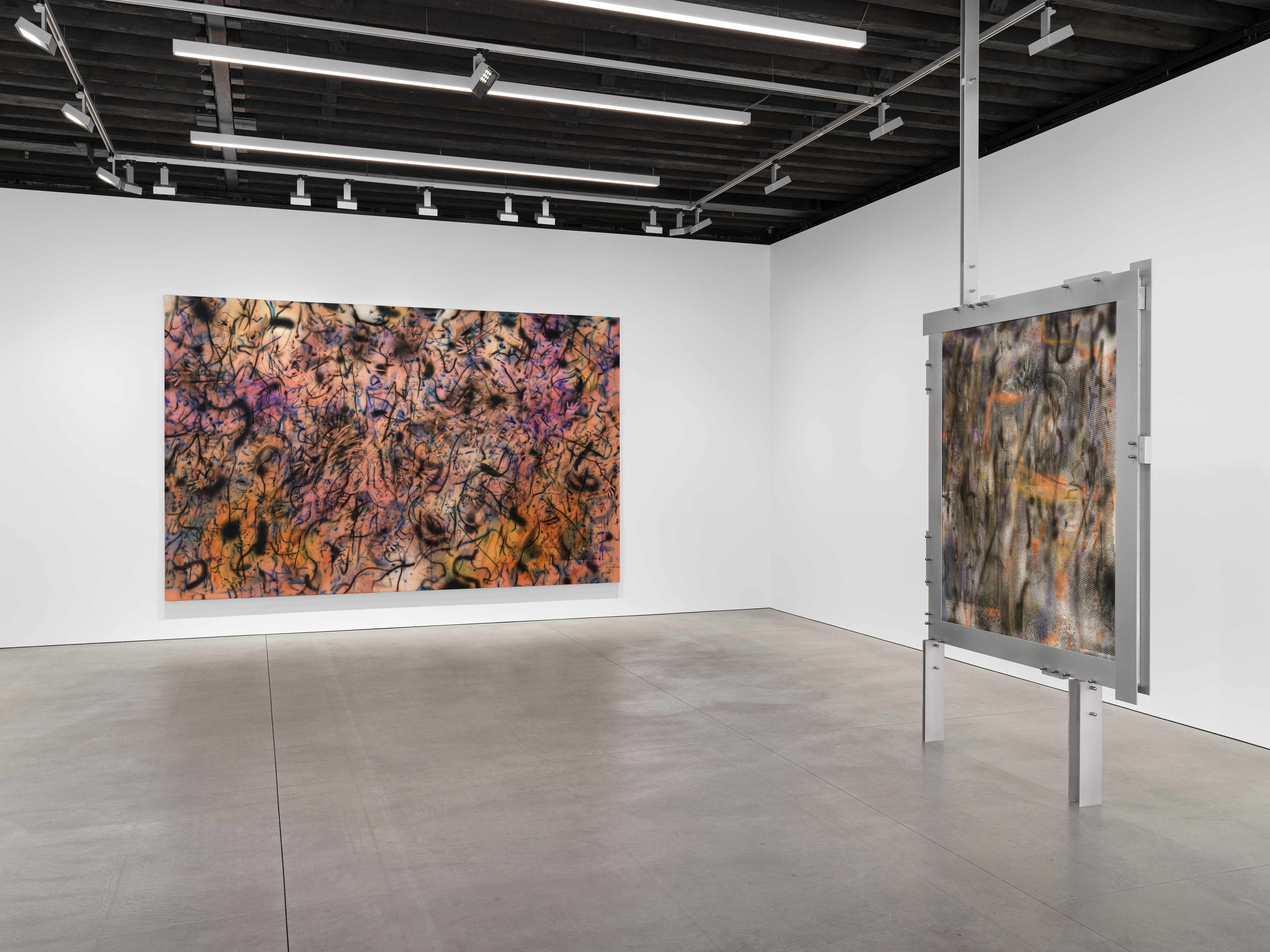
The second floor has more of a concentration of the smaller TRANSpaintings, it’s more intimate, it doesn’t have as tall of a ceiling height. There’s one large painting as you turn the corner, and you get this vista into a larger landscape format abstract painting. It relates to the TRANSpaintings on that level. Those transparent paintings are made in collaboration with Nairy Baghramian; she made sculptural parts for the paintings called Upright Brackets, so they’re actually co-authored by both of us and they’re sculpture as well as painting as well as animatronics. They are completely interdependent.
And they change a lot. Each of these paintings is very mutable and unstable in terms of what they seem to be as an image. They change constantly with your perspective and how the light is hitting them. Other people (and the colors they’re wearing) behind or in front of these paintings affects what we see. They are constantly mutating and shifting, and I found that shapeshifting compelling.
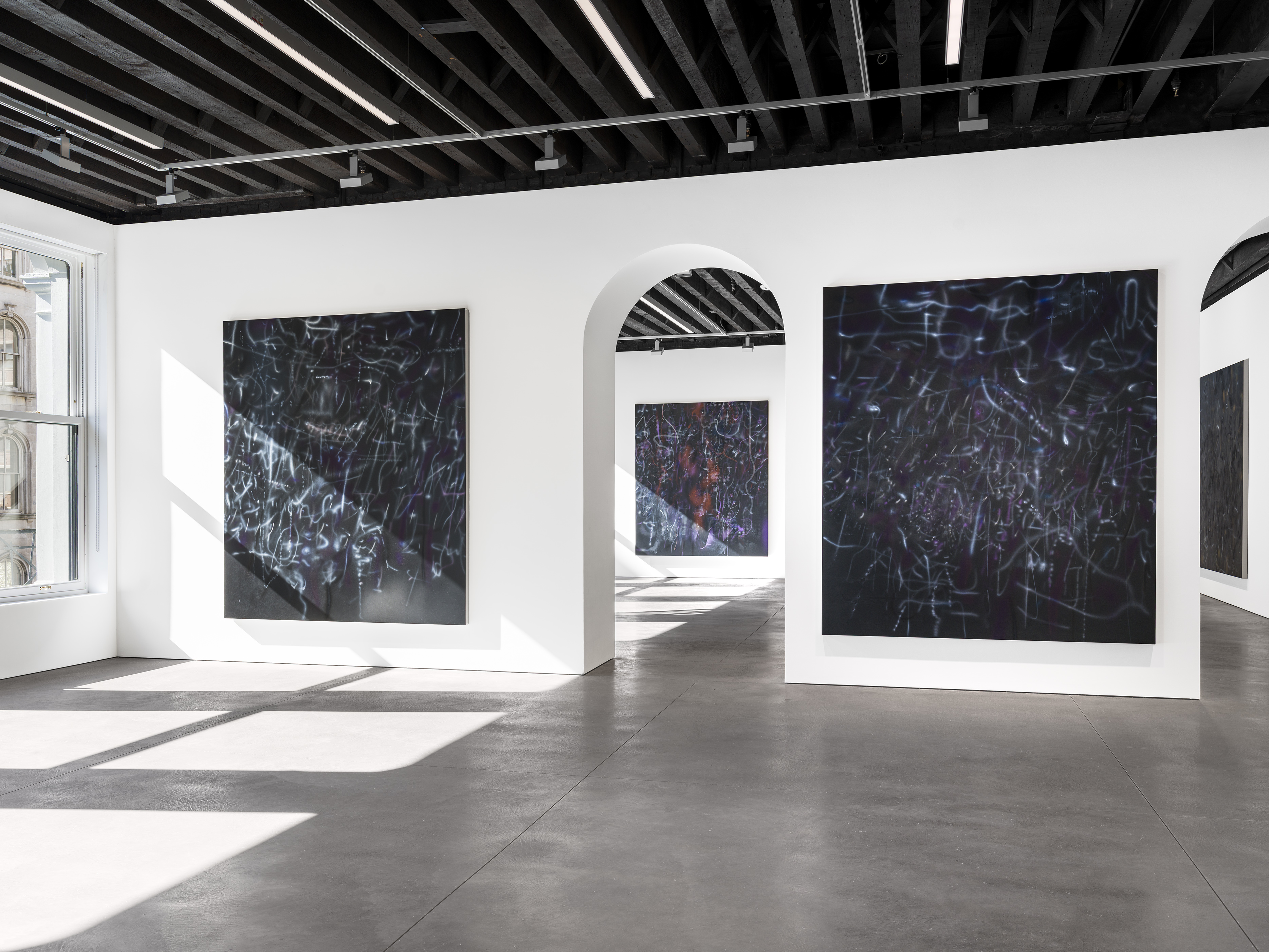
The third floor is comprised of Black Paintings, which have all kinds of interference pigments, as well as black paint, and silver and white paint. There is reflective material as well as material that absorbs light. They are going in and out of focus; ghosts seem to appear and disappear. Marks come and go. A color you think you saw two minutes ago, you don’t see if you shift your stance. They’re not fixed; they are constantly evolving and changing. And they play with our perception quite a bit. I think all of that kind of contributes to the lack of stability and flux, the complexity of such violence occurring at the same time as such emergence.
With the title, I was thinking a lot about the transience of a shadow and the kind of fugitiveness of our days and realities, and our efforts to make sense of things. What is true and what is not true? We live in this time that feels terrifying due to the palpable histories it brings up. But at the same time we also know that this is a very different world; whatever is happening today is going to be history tomorrow. I’m thinking of that sense of passing and fleetingness and the desire to make sense of this moment, the non-abidance reality that we are immersed in.
DC: On one hand your paintings can feel like archaeology where you can dig into these layers of strata upon strata, but they also feel slippery and evasive, like outer space, constantly in motion.
Yes, or like our bodies.
DC: Are there reference points that you’re thinking about with these paintings? They’re abstract works but in hearing you speak about them there are all of these different reference points in terms of metaphor for thinking through them. Are there any visual references that you’re pulling from as well? As you go about life are you collecting visuals constantly?
Yes, there are references from the past thirty years of being engaged in mark-making. I think that inside the paintings you will see aspects of many of those histories of mark-making from the handprint to the silhouette of the hand all the way to a scratched mark that looks like it’s made with a stick instead of a brush. If a mark is made with spray or a mark is made with a printed material, they affect how you visually see the mark and how the material works.
I think the binary of abstraction and representation is a false binary in so many ways. I think we tend to look for references in abstraction, and I think we tend to work with representational work with a lot of gestures of abstraction. There are body parts, there are moments that feel like bodies in motion, ghosts, traces of a body, or the traces of a hand, a place that’s falling apart, a body that’s falling apart.
DC: If you could take us back to your time in Michigan, when you were working on your BA at Kalamazoo did your paintings look similar to the way they look now? Were you working in abstraction? What would be something you think was present in your work then that feels like it has continued on through your current work?
I was working much more representationally. I was making portraits of my friends, relatives, and partners at the time. I was working with women, I was making these portraits of Black women in my life. I was really kind of taken with how I could break down the face and work with bold color and abstraction a little bit. But it was student work. I think the one thing that was there that is still there is this effort to make sense of the world and to try to figure out where I am and where we are in that—trying to find where our potency and our limits are, what liberates us, and what enslaves. I think that is still what I am interested in.
DC: Do you see your work as having social and political responsibility? Do you see it as having social or political opportunity? If so, what do you see as the biggest opportunities or responsibilities within your work?
I think art in general, because it is a social medium, is something that doesn’t exist by itself in a vacuum. It can exist without people seeing it, but then does it really exist? I think it is fundamentally a social medium. It’s to be engaged with, and in that sense I think it participates in the construct of it.
Now I don’t like to put the social and political responsibility onto creative people. I really think about the creative process and the space of the imagination as a space of freedom and a space of liberation, and if that’s the case, it’s a place to find freedom from the constraints of the social and the political.
In many ways it’s this place in between. It’s a complicated place, but it’s a really ripe, potent, and fecund place; I think that’s how it can be politically powerful.